
Comparing AI Language Apps: Latency, Intelligence & Multilingual Support (July 2026)
There's a gap between how an AI language app looks in a review and how it feels when you're mid-conversation and the response takes two seconds too long. Latency, model intelligence, and multilingual support are the three things that shape that experience, and they're rarely what comparison posts focus on. Here's what six apps actually do on those three dimensions.
TLDR:
- Gamified apps train recognition; AI voice tutors train production. Swain's Output Hypothesis (1985) explains why only one closes the speaking gap
- Conversation latency above roughly 300ms changes what you practice, replacing fluency reps with hesitation rehearsal
- Shallow AI models produce a specific failure: 20 minutes of friendly, empty exchange where you leave without noticing a single error
- A language count on a marketing page tells you little. Check whether the app handles your regional accent and mixed-language input before committing
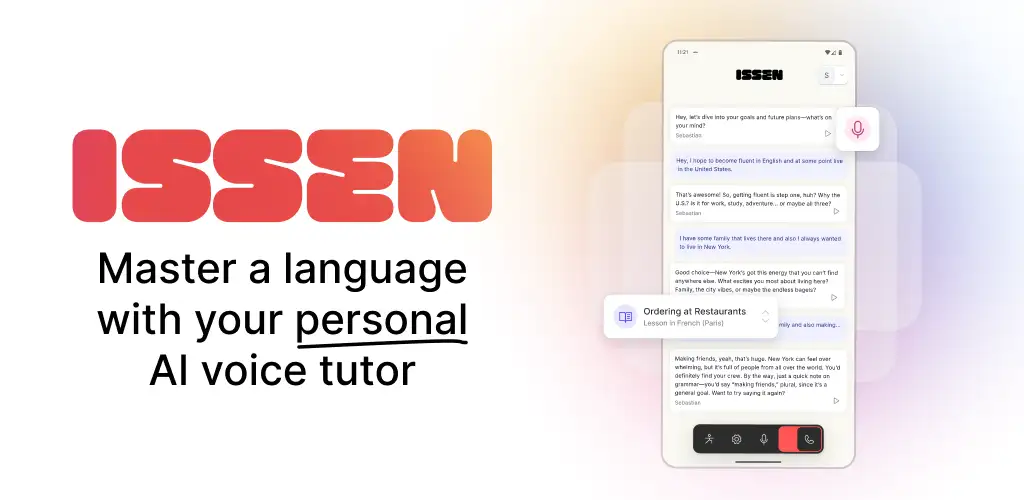
- ISSEN is a real-time voice tutor covering 60+ languages with specific regional accents, session memory that resurfaces errors across conversations, and background mode for practice on the move
What separates AI voice tutors from gamified language apps
Gamified apps and AI voice tutors solve different problems, even though they sit next to each other in the App Store. The first category optimizes for a 5-minute streak, a tap on the right multiple-choice answer, and slow vocabulary retention. That works for beginners building word counts. It runs out of road once you need to produce a sentence under conversational pressure.
Voice tutors demand spoken output, not tapped input. Swain's Output Hypothesis (1985) argues that speaking practice in your language routine forces learners to notice the gaps their reading brain glides past. Multiple choice never triggers that noticing. A live back-and-forth with an AI tutor does, because every turn requires you to pull a sentence out of memory in real time.
That is the categorical split: one trains recognition, the other trains production.
Why conversation latency shapes the speaking experience
Human conversation runs on tight timing. Stivers et al. (2009, PNAS) found the average gap between speakers across ten languages sits at around 200 milliseconds, and once a response lags past roughly 300ms the exchange starts to feel unnatural, learners feel it before they can name it.
Long delays quietly change what you practice. Understanding how AI speaking practice works helps explain why when the tutor takes two seconds to reply, you stop thinking in the target language and start narrating your sentence in your head, checking it, waiting: dictation with an audience, not real speaking.
Latency also shapes confidence. When you pause and hope the app caught what you said, hesitation becomes the thing you rehearse, and the fluency rep you wanted gets replaced by a slower, less productive one.
How AI model intelligence affects what you actually learn
Model quality shows up fast. Within three or four turns, you can tell whether the tutor is tracking your sentence or pattern-matching keywords and returning a plausible follow-up question. Cheaper models tend to do the second thing, which feels fine for a minute and then hollow.
A capable current model does the work a tutor is supposed to do, applying effective language learning techniques like noticing you used the wrong preposition two turns ago and circling back. It varies vocabulary at your level instead of parroting the last noun you said. It picks up on hesitation and rephrases the question instead of plowing ahead.
Shallow models produce a specific failure mode: friendly, endless, empty. You will talk for 20 minutes and leave without noticing anything you got wrong.
Multilingual support, accent coverage, and code-switching
A language count on a marketing page tells you very little. What matters is whether the app parses your accent, handles a code-switch when you blank on a word, and offers the regional variant you need. Speech recognition quality drops on lower-resource languages, and most apps rely on generic transcription that flattens regional pronunciation into a single "standard" target.
Three questions worth asking:
- Does the app recognize the regional accent you plan to speak with (Rioplatense Spanish, Kansai Japanese, Egyptian Arabic)?
- What happens when you drop an English word into a Spanish sentence because you cannot remember the term?
- Does transcription hold up on low-resource languages, or degrade to keyword matching?
In our testing, ISSEN was the only app in our set that accepted mixed-language input without breaking the conversation, a result of how AI language tutoring changes fluency outcomes. The rest expect clean monolingual speech.
App-by-app comparison: Praktika, Speak, Duolingo Max, Talkpal, and general AI tools
Each app below is assessed on the three dimensions in the post title: latency, model intelligence, and multilingual support, plus primary audience fit. Verify pricing and tier scope on the live site before subscribing.
App | Best for | Latency | Model intelligence | Language / accent coverage |
|---|---|---|---|---|
ISSEN | B1+ learners building speaking fluency | Real-time (smart turn detection, no push-to-talk) | Adaptive; holds context and resurfaces errors across sessions | 60+ languages; regional accents (Argentina, Mexico, Spain for Spanish; British, American, Australian for English); accepts mixed-language input |
Praktika | Beginners wanting structured, scenario-driven lessons | Noticeable (turn-based exchange with avatar layer) | Scenario-driven; clear beginner path | 9+ languages |
Speak | Beginners in a small set of high-demand languages | Fast within drill format | Scripted turns; limited open-ended production | English, Spanish, Korean, Japanese |
Duolingo Max | Gamified learners adding AI conversation practice | Fast | AI-powered; guided, not open-ended | German, Spanish, French, Italian, Portuguese |
Talkpal | Budget-conscious learners across many languages | Lags behind voice-first tools; turn detection inconsistent | GPT-powered; thin accent controls | ~35 languages; accent controls limited |
ChatGPT / Gemini / Claude | Self-directed learners who can write their own prompts | Fast (text-based by default) | Strong general models; no adaptive curriculum or progress tracking | Wide language support; no regional accent targeting |
Praktika
- Where it works: avatar-based conversations across 9+ languages with scenario-driven lessons that give beginners a clear path.
- Where it falls short: turn-based exchanges introduce noticeable latency, and the avatar layer favors visual novelty over conversational speed.
Speak
- Where it works: drill-style exchanges optimized for beginners in English, Spanish, Korean, and Japanese.
- Where it falls short: scripted turns limit open-ended production, and language coverage is narrower than most peers here.
Duolingo Max
- Where it works: AI-powered Video Call and Roleplay layered onto the gamified core, covering German, Spanish, French, Italian, and Portuguese; Video Call also extends to Japanese, Korean, and Chinese.
- Where it falls short: AI features stay guided, not open-ended, so advanced learners exhaust the format quickly.
Talkpal
- Where it works: GPT-powered conversation across roughly 35 languages at a lower monthly price.
- Where it falls short: latency and turn detection lag behind voice-first competitors; accent controls are thin.
General AI chat tools (ChatGPT, Gemini, Claude)
- Where they work: capable conversation partners with strong current models, useful for freeform practice if you can prompt them well.
- Where they fall short: no curriculum, no adaptive difficulty, no progress tracking, no turn detection built for spoken exchange. A 2024 AI chatbot speaking practice review notes anxiety and engagement benefits, with the caveat that general tools are not built as teachers.
What general-purpose AI chat tools can and cannot do for language learning
ChatGPT, Gemini, and Claude are useful for learners who know what they need. Ask for a grammar explanation, paste a paragraph for correction, or run an open-ended text exchange in your target language, and you get a competent response at a fraction of the cost of a dedicated app. For self-directed learners, that is real value.
General tools have structural limits that have nothing to do with model quality. They wait for you to lead. They will not open a session with a topic tailored to your last stumble, chase a preposition error two turns later, or resurface a word you forgot last week. That gap is why AI apps for real conversations are built differently. Every session starts cold.
If you can write your own prompts, set your own drills, and track what you got wrong yesterday, a general chat tool works. If you cannot, you practice whatever you already know.
How to choose an AI language app based on your level and goals
Before you install anything, name your situation. Understanding what AI language learning is helps clarify which category follows from your level and what you need to do next, not from a ranking.
- A1 to A2, building a base: structured beginner apps with lesson paths (Speak, Duolingo). You need vocabulary volume and predictable drills before free conversation pays off.
- Preparing for a specific event (a trip, an interview, a work call in six weeks): scenario-based tools that drill the exact register you will need. Short and situational.
- B1 and above, stuck on production: open-ended AI voice tutors that generate high-volume unpredictable conversation, including solo language speaking practice routines. This is where the plateau breaks, and where gamified apps stop helping.
- Specific accent or phonemic gap: dedicated shadowing tools with regional accent coverage, used alongside your main practice.
Pick the category first. Pick the product second.
Best Overall AI Voice Tutor: ISSEN
The three dimensions in this post map directly onto how our AI voice tutor is built. Smart turn detection removes push-to-talk mechanics, so exchanges run at natural conversational pace. The tutor drives the session, adapts vocabulary within a single turn, and holds context across sessions so a preposition you missed on Tuesday resurfaces Thursday in a new sentence. Voice tutoring covers 60+ languages with specific regional accents (Argentina, Mexico, Spain for Spanish; British, American, Australian for English).
Background and lock-screen mode keeps practice going while you walk or commute, making it one of the best language learning apps for speaking. Conversation-anchored SRS flashcards surface each word inside the sentence you used it in. Progress is measured in minutes of spoken output, not streaks.
Priya is a nurse in Chicago prepping for a hospital interview in six weeks. Session memory will soon pre-load intake phrases she stumbled on last week before she opens the app.
Try ISSEN free for 10 minutes at issen.com.
Final thoughts on comparing AI voice tutors and language learning apps
The right tool for vocabulary building and the right tool for speaking confidence are rarely the same app, and conflating them is where most learners get stuck. Name your actual gap first, then match the tool to it. Your speaking reps will get more useful fast when the tool is built for production, and ISSEN lets you try that for free in 10 minutes.
FAQ
What's the difference between ISSEN and Duolingo Max for advanced learners?
Duolingo Max layers GPT-4-powered Roleplay and Video Call onto a gamified core covering German, Spanish, French, Italian, and Portuguese, but those AI features stay guided, not open-ended; advanced learners exhaust the format quickly. ISSEN runs open-ended voice conversations across 60+ languages, adapts vocabulary and difficulty within a single turn, and holds context across sessions, which is where the plateau for B1-and-above learners actually breaks.
Can I use an AI language app without push-to-talk mechanics?
Yes. ISSEN uses smart turn detection, so exchanges run at natural conversational pace without button-initiated turns. Among the AI voice tutors compared in this post (Praktika, Speak, Talkpal, and others), this is exclusive to ISSEN, and the difference is audible: push-to-talk trains you to pause and check yourself, not to speak.
What can ChatGPT do for language learning that a dedicated AI tutor can't replace, and where does it fall short?
ChatGPT handles grammar explanations, text correction, and freeform conversation in your target language competently, and costs less than most dedicated apps. The structural limits are that it starts every session cold with no memory of you, won't chase an error two turns later, and has no adaptive difficulty or progress tracking. The result: you practice whatever you already know, not what you need to fix.
How do I know whether to use Speak, Duolingo, or an AI voice tutor like ISSEN for my level?
The category follows from where you are: A1 to A2 learners building vocabulary need structured lesson paths, which Speak and Duolingo provide well. If you're preparing for a specific short-term event (a trip, an interview in six weeks), scenario-based tools that drill a single register work better. B1 and above, stuck on production, is where open-ended AI voice tutors earn their place, because gamified apps stop generating the unpredictable conversational pressure that breaks the plateau.
Does ISSEN support mixed-language input if I blank on a word mid-conversation?
Yes. ISSEN accepts multilingual input (Spanglish, for example) without breaking the conversation. Among the six apps reviewed here, including Praktika, Speak, Talkpal, Duolingo Max, and general AI chat tools, none of the others handle this; they expect clean monolingual speech, which means a dropped English word mid-sentence disrupts the exchange instead of being absorbed naturally.