
B1 to C1 With AI: Stories From Real Learners (July 2026)
If you're somewhere around B1, you probably know the feeling: good enough to get by, not quite able to say what you actually mean without slowing down or simplifying. That gap between what you understand and what you can produce in real time is a known phenomenon in language acquisition, and there are patterns for crossing it. These are the stories of people who did.
TLDR:
- The B1 plateau persists because you have enough passive knowledge to survive conversations, so you stop producing the harder output that drives real growth.
- Swain's Output Hypothesis (1985) explains the mechanism: speaking under real-time pressure forces you to notice gaps between what you mean and what you can actually say, pushing passive knowledge into active use.
- A 2026 Frontiers in Education study linked repeated AI-mediated speaking practice to utterance fluency gains in intermediate learners; 15 minutes daily outperforms a 90-minute weekly lesson because automaticity builds through frequency.
- Learners who reach C1 consistently share four habits: short daily sessions over weeks, topic-driven motivation, tolerance for stumbling, and treating errors as data instead of failure.
- ISSEN's AI voice tutor drives conversation from the first turn, adjusts difficulty in real time, and runs in background mode so commute time becomes speaking reps; pairing it with a human tutor every week or two covers the fossilized errors daily practice alone won't catch.
What the gap between B1 and C1 actually looks like
At B1, you can hold a conversation about your job, your weekend, your commute. You follow a slow podcast if the topic is familiar. When someone changes register or throws in a joke that hinges on a phrasal verb, you lose the thread and reach for the nearest simple word.
C1 is a different kind of speaking. You argue a point without rehearsing it. You catch nuance in a colleague's tone and respond in kind. You produce complex sentences without stopping to assemble them, and when you stumble, you recover mid-clause instead of resetting.
The distance between those two states is real and closable, and most of the work happens in spoken output.
Why intermediate learners stop improving before C1
Jack Richards described this plateau in 2008 as a predictable stage where learners settle into a functional but limited version of the language. You can order food, run a meeting, explain your job. Your workarounds have gotten so smooth you barely notice using them. Safe grammar carries the sentence, and the conversation ends without incident.
That comfort is the trap. At B1 you have enough passive knowledge to survive most exchanges, so you stop pushing into the territory where you would fumble. Growth requires the fumbling. Teachers see this pattern often enough that it has a name in the field, the intermediate plateau, and it tends to last for years when nothing changes about how you practice.
The shift that actually moves the needle
Learners who break through this plateau shift the ratio of their practice hours toward spoken production under real-time pressure, a core principle behind AI English fluency. More reading does not close the gap. More grammar drills do not close it either.
Merrill Swain called this pushed output. Her 1985 Output Hypothesis argues that producing language forces you to notice the gap between what you meant to say and what you can actually say. Reading lets your brain glide over that gap. Speaking under time pressure surfaces it turn by turn, and the noticing is what pushes passive knowledge into active use.
The shift is qualitative: the switch from receiving language to being cornered into producing it.
How daily AI speaking practice works mechanically
A daily session looks small on paper. Here is how AI speaking practice works: you open the app, pick a topic or let the tutor pick one, and you are talking within about 30 seconds. The tutor asks a question at your level, listens, responds, and nudges you harder when you handle something cleanly. When you fumble, it circles back to the same structure a few exchanges later in a different frame.
Four mechanics do the work:
- Adaptive difficulty inside a single turn, so vocabulary and pace track your ceiling instead of a fixed script.
- Real-time conversational pressure, which forces retrieval instead of recognition.
- Immediate corrective feedback woven into the reply, not queued for a weekly review.
- Speaking reps you can accumulate any day, without booking a tutor.
A 2026 Frontiers in Education study linked repeated AI-mediated speaking practice to gains in utterance fluency for intermediate learners. Fifteen minutes daily beats a ninety-minute lesson once a week because automaticity is built through frequency.5
Patterns that appear across learner stories
Read enough B1-to-C1 accounts and the same four habits keep surfacing:
Habit | What it looks like in practice | Why it moves the needle |
|---|---|---|
Short daily sessions | 10 to 20 minutes most days instead of a 3-hour Saturday marathon | Automaticity builds through frequency, not volume: 15 minutes daily outperforms a 90-minute weekly lesson |
Topic-driven motivation | Talking about work problems, a hobby, or a real family situation | Motivation carries vocabulary in; abstract drills don't stick the way personally relevant language does |
Tolerance for stumbling | Letting the tutor push complexity without asking it to slow down | Growth requires fumbling in territory where you'd normally reach for a safe workaround |
Errors as data, not verdicts | Logging a missed subjunctive as a note for tomorrow's session | Treating mistakes as information keeps output volume high; fear of error shrinks sentences and slows gains |
None of this is exotic. This is the boring version of practice most learners avoid because the interesting version feels more productive.
Why judgment-free practice changes output volume
The math on why anxiety matters is simple: fewer reps means slower gains. Fear of speaking a foreign language carries a social cost, and at B1 that cost is high enough to make you edit sentences down to whatever you can say cleanly. You produce less, and what you produce is safer than what you could have attempted.
An AI tutor removes the audience. A 2024 review of AI tools for speaking practice found meaningful benefits for anxiety reduction and speaking outcomes among learners using AI conversation partners, a pattern developed further in research on AI English learning for non-native speakers. When the stakes drop, sentences get longer, attempts get riskier, and pushed output climbs into the range where automaticity forms.
Fitting speaking practice into an already full day
The learners who close the B1 to C1 gap rarely carve out a fresh hour, and AI language tutoring for speaking fluency explains why that shift is now more accessible. They graft speaking onto things they were already doing.
- The walk to the train, one way, gets you 12 minutes of open conversation.
- Cooking dinner adds another 20 if the phone stays on the counter.
- The dog needs walking twice a day anyway, so run a session on the second loop.
- Waiting for a meeting to start, or for a kid to finish practice, adds five to ten more.
Stack four of those into a weekday and you have 40 to 60 minutes of spoken output without touching a scheduled study block. Over a month, that pile of small windows is where fluency accumulates.
What AI conversation practice cannot do on its own
Daily AI reps will not catch every fossilized error you have carried since B1. A human tutor who has taught your L1 group before spots the calcified mistakes you no longer notice, and can correct them. Cultural pragmatics, the register moves that read as rude or overly formal to a native ear, also land better with a human partner in a real context.
The model that actually gets people to C1 pairs the two: the best AI language tutors for conversation practice handle daily volume between sessions, while a human tutor every week or two provides targeted correction and accountability.
How ISSEN fits into the B1 to C1 shift
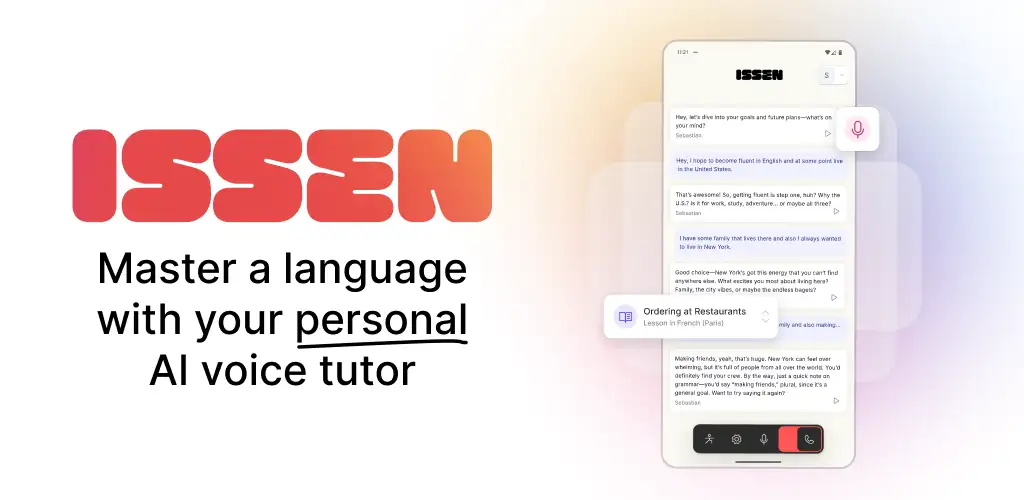
Everything above points to a specific kind of practice. Our tutor drives the conversation from turn one, adjusting vocabulary, pace, and sentence complexity to hold your i+1 band throughout a session (at placement and continuously from there), a design standard you can compare across the best language learning apps for speaking. Background mode runs from a locked screen, so the walk to the station becomes 15 minutes of spoken output without the phone in hand. When new vocabulary surfaces mid-conversation, ISSEN pulls it into a flashcard tied to the sentence you actually used it in, not a generic word list.
Pair this with a human tutor every week or two for correction, and you have the model that closes the B1 to C1 gap. Start a 10-minute conversation at issen.com to see how the format runs.
Final thoughts on becoming fluent with AI: real stories
What the real stories share is boring in the best way: consistent daily reps, topics that actually mattered to the learner, and a refusal to hide behind safe grammar when things got hard. Think of someone like Amara, a logistics coordinator in Lagos who needs workplace English for a new regional role. Instead of waiting for a scheduled lesson, she runs 15 minutes with ISSEN on her walk to the office, then another session while cooking dinner. Six months of that routine, and the meetings she used to dread are likely to feel manageable. AI practice handles the volume and removes the anxiety that shrinks your sentences down to whatever you can say cleanly; a human tutor every week or two handles the correction. Start a 10-minute conversation with ISSEN to see how that daily rep actually runs.
FAQ
Can you actually become fluent with AI, or does it just help with vocabulary?
AI conversation practice targets a different problem than vocabulary: it builds spoken automaticity, the ability to produce language under real-time pressure without mentally translating first. Vocabulary apps train recognition; speaking with an AI tutor forces retrieval, which is the mechanism that converts passive knowledge into fluent output.
What's the real difference between B1 and C1, and how long does closing that gap take?
B1 means you can hold familiar conversations with workarounds; C1 means you argue a point, catch register changes, and recover mid-clause when you stumble. The timeline varies widely depending on daily practice volume. FSI estimates roughly 550 to 600 classroom hours for Spanish overall, but learners who move their practice toward daily spoken output consistently close intermediate-plateau gaps faster than those who add more reading or grammar study.
Should I use ISSEN or a human tutor on Preply or italki to go from B1 to C1?
Both serve different functions and work best in combination. ISSEN gives you daily speaking reps at low cost without scheduling, which is where automaticity forms; human tutors on Preply or italki catch fossilized errors and handle cultural pragmatics that accumulate over months of AI practice. The model that actually moves learners to C1 uses AI for volume and a human tutor every week or two for targeted correction.
How do I fit daily speaking practice into a schedule that already has no free time?
The learners who reach C1 rarely block out a fresh study hour. Instead, they attach speaking sessions to things already in their day. A one-way walk to the train runs about 12 minutes; cooking dinner adds 20; a second dog walk fills another session. Stack three or four of those windows across a weekday and you accumulate 40 to 60 minutes of spoken output without touching a dedicated study block.
What does Swain's Output Hypothesis actually mean for intermediate language learners?
Merrill Swain's 1985 Output Hypothesis argues that producing language forces you to notice the gap between what you meant to say and what you can actually say, a gap that reading and listening let your brain skip over entirely. For intermediate learners, more input alone won't close the B1-to-C1 distance; the work happens in spoken exchanges where you're cornered into pulling sentences from memory under time pressure.