
ISSEN vs Duolingo: Best App for Speaking (September 2026)

Reading a menu in Spanish is one thing. Ordering out loud without your brain locking up is a different skill entirely, and no amount of multiple choice will bridge that gap on its own. If you're looking for the best app for speaking practice and trying to figure out whether Duolingo's newer AI features get you there, here's how the two approaches actually compare when you start talking.
TLDR:
- Duolingo Max adds push-to-talk AI dialogue with Lily in five languages, while ISSEN runs open-ended voice conversation from turn one across 60+ languages
- ISSEN's tutor remembers your interests and stumbles across sessions and adjusts difficulty turn by turn to stay in Krashen's i+1 band
- Pronunciation lives in a separate Shadowing mode with six regional accents, backed by a 44-study review linking shadowing to fluency and prosody gains
- Cost per minute reveals the real gap: two 5-minute Max calls weekly logs ~40 minutes; 20 minutes daily on ISSEN logs 600 at a flat $20 to $29 USD
- Use Duolingo for early vocabulary drilling; add ISSEN when you need speaking reps tap exercises cannot supply
Dimension | Duolingo (Max) | ISSEN |
|---|---|---|
Speaking format | Push-to-talk Video Call with Lily and Roleplay, guided and predictable | Open-ended voice conversation from turn one with smart turn detection |
Language coverage for AI speaking | Five languages (German, Spanish, French, Italian, Portuguese) | 60+ languages |
Accent options | Not offered at phoneme level | Six regional accents in Shadowing mode (American, British, Australian, Argentinian, Mexican, Castilian) |
Personalization | Curriculum-level; skill tree resurfaces past mistakes | Turn-by-turn difficulty adjustment; cross-session memory of interests and stumbles |
Vocabulary review | Adaptive algorithm inside structured exercises | Flashcards pulled from your own speech, anchored to original sentence and topic |
On-the-go practice | 5 to 10 minute tap sessions | Background mode from the lock screen during walks or commutes |
Realistic monthly speaking minutes | ~40 min (two 5-min Video Calls weekly) | ~600 min (20 min daily) |
Pricing | Max tier, varies by market, above Super Duolingo | Flat $20 to $29 USD/month, unlimited practice |
What is Duolingo?
Duolingo is a gamified language app offering bite-sized lessons across 40+ language courses overall, built around streaks, XP, and multiple-choice exercises. Its Duolingo Max tier adds AI-driven features like Video Call with Lily and Roleplay, though AI Video Call currently covers only five courses: Spanish, French, German, Italian, and Portuguese.
What is ISSEN?
ISSEN is a real-time AI voice tutor built for speaking across 60+ languages, available on iOS, Android, and web, and one of the AI language learning apps with voice practice covered in our broader roundup. The tutor drives the conversation, adapts difficulty turn by turn, and remembers your interests and stumbles across sessions. Sessions start on demand in about 30 seconds, run unlimited on a flat monthly plan, and work in background mode so you can practice while walking or commuting. In-context flashcards surface words from your own conversations, tied to the sentence and topic where you first used them. ISSEN sits inside a broader study plan alongside grammar work and real-world exposure.
Speaking practice and conversation design
Duolingo's core loop is tap-based multiple choice with short "Speak" prompts scattered in. On the Max tier, Video Call with Lily and Roleplay add push-to-talk AI dialogue in German, Spanish, French, Italian, and Portuguese as of November 2025, but exchanges stay guided and predictable.
ISSEN runs open-ended conversation from turn one. Smart turn detection replaces push-to-talk, so the tutor waits when you hesitate and responds when you actually finish a thought.
If you want gamified drills with occasional AI dialogue, Duolingo fits. If you need daily conversational reps under real pressure, ISSEN is built for that.
Personalization, memory, and adaptive difficulty
Duolingo personalizes at the curriculum level. Placement tests sort you into a skill tree, and the algorithm resurfaces past mistakes inside the same structured path everyone else walks. The lesson itself does not bend to what you said 30 seconds ago.
Your ISSEN tutor personalizes inside the conversation. Vocabulary, sentence complexity, and pace shift turn by turn to keep you inside Krashen's i+1 band, where input sits just above your current level so acquisition can happen. Mention your sister is flying to Lisbon next weekend and the tutor pivots into restaurant phrases. Come back tomorrow and it remembers the trip, the grammar form you fumbled, and that you care about tennis more than cooking.
Pronunciation, accents, and feedback
Duolingo's Speak exercises use speech recognition to check scripted prompts, marking whole phrases right or wrong instead of flagging individual sounds. Max's Video Call with Lily offers gentle help when you stumble but does not score pronunciation at the phoneme level.
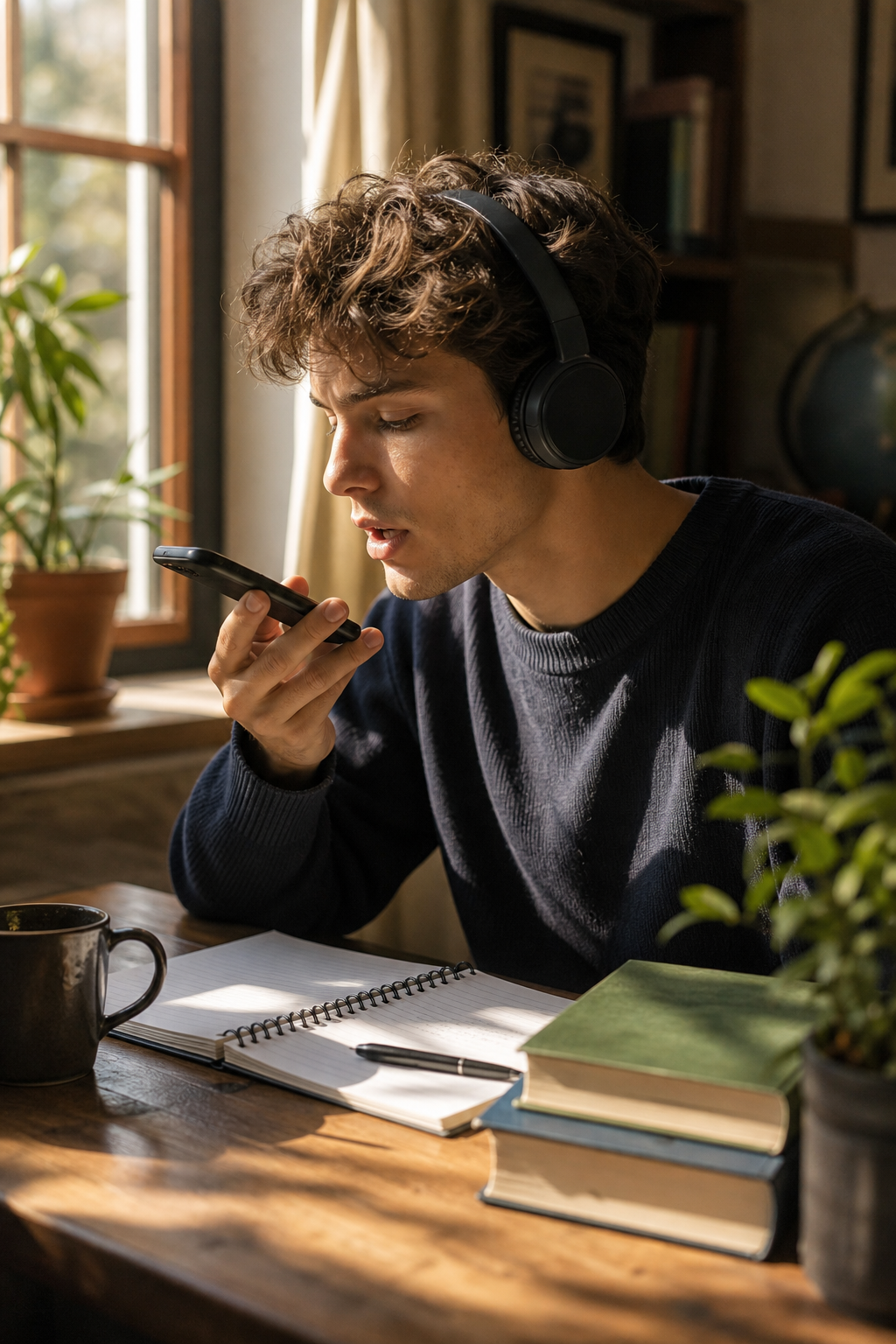
ISSEN's voice conversations focus on production without interrupting to correct sounds; pronunciation work happens in a dedicated Shadowing mode through pause-and-repeat drills across six regional accents: American, British, Australian, Argentinian, Mexican, and Castilian.
That split follows the research. A 44-study review found shadowing improves comprehensibility, fluency, and prosody through close imitation of native speech.
Vocabulary retention: flashcards and spaced repetition
Duolingo cycles previously seen words through its lesson tree using an adaptive algorithm to surface items it predicts you're weakest on. Reviews stay inside structured exercises, decoupled from any conversation.
ISSEN, one of the language learning apps with AI voice practice, pulls flashcards directly from your own speech. Each card carries the sentence you used the word in, the topic, and the tutor's response, so review reconstructs the original context instead of testing an isolated pair.
Paul Nation's word-card research shows deliberate vocabulary study works best when paired with meaning-focused use, not as a replacement for it.
Daily habit formation and on-the-go practice
Duolingo's habit engine runs on streaks, XP leaderboards, and push notifications, pulling you back for a 5 to 10 minute tap session on the couch or in line for coffee. Short sessions, instant feedback.
ISSEN, among the best AI language tutors for conversation practice, builds the habit around your voice. Background mode keeps a session running from the lock screen while you walk the dog, ride the bus, or wash dishes, turning the 20 minutes between meetings into 20 minutes of actual talking.

Duolingo builds a tapping habit. ISSEN builds a talking habit. Which one you need depends on the skill you're trying to automate.
Language coverage and accent options
Duolingo offers 40+ language courses, though depth varies widely and Max's AI Video Call and Roleplay currently cover only German, Spanish, French, Italian, and Portuguese. Learning Japanese, Arabic, or Vietnamese gets you lessons but no AI conversation.
In the broader AI vs. human tutor debate for speaking practice, ISSEN supports voice tutoring in 60+ languages, with accent options inside each: Spanish (Argentina, Mexico, Spain), English (British, American, Australian), and similar regional splits elsewhere.
That matters if you're preparing for Buenos Aires in particular, or need to sound natural to Mexican patients at work. Generic "Spanish" flattens distinctions native ears catch immediately.
Pricing and free access
Duolingo offers a free ad-supported tier, Super Duolingo for ad-free study, and Duolingo Max as the top tier that unlocks Video Call and Roleplay. Max pricing varies by market and sits well above Super.
As with other AI language learning platforms, ISSEN runs $20 to $29 USD per month depending on plan and country, with unlimited daily practice and a 10-minute free trial.
Cost per minute of speaking is what matters. A Max subscriber doing two 5-minute Video Calls a week logs roughly 40 minutes of AI conversation monthly. An ISSEN subscriber doing 20 minutes daily logs 600 minutes at a flat rate. Divide either monthly price by your realistic usage and the gap widens fast.
Who each app is best for
Duolingo fits you if
- You're a true beginner building first vocabulary and grammar exposure.
- Streaks and XP keep you coming back for five-minute tap sessions on the bus.
ISSEN fits you if
- You're intermediate or advanced, past the beginner-app stage, and need speaking reps to break the plateau.
- You're an immigrant, remote worker, or professional with real conversational stakes at work, school, or the leasing office.
- Your practice windows are fragmented into 10 to 15 minute gaps between meetings and commutes.
The two can sit in the same stack. Use Duolingo for early vocabulary drilling. Add ISSEN when you need the speaking layer that closes the gap gamified apps leave in speaking fluency practice.
Why ISSEN Is the Better Choice for Real Speaking Practice
Duolingo handles gamified vocabulary retention well, and Max's Video Call with Lily is a real addition for casual dialogue inside its own ecosystem. Among the best language learning apps for speaking, ISSEN fits better for actual spoken fluency: real-time voice conversation without push-to-talk, cross-session memory, conversation-anchored flashcards, a dedicated Shadowing mode, and background practice that turns commutes into speaking reps.
Try ISSEN free for 10 minutes and see how AI language learning feels as a real conversation.
Here's what that looks like in practice. Among the top AI voice tutors for language learning, picture Hana, a nurse in Seoul whose hospital recently started seeing Spanish-speaking patients. Her tutor opens the session already knowing she stumbled on "cuanto tiempo lleva con el dolor" in her previous session, pre-loads tomorrow's intake scenarios, and holds her at the register a patient in distress would actually use. Daily conversational reps under real pressure are what close the gap between reading a chart and running an intake.
Final thoughts on the best app for speaking practice
Gamified drills and open conversation solve different problems, and you can absolutely run both. When the leasing office, the standup, or the intake form is next week, tap exercises will not close that gap. Start your first ISSEN conversation and turn tomorrow's commute into speaking reps.
FAQ
Should I use ISSEN or Duolingo if I'm a complete beginner with no vocabulary base?
Duolingo is the better starting point if you cannot yet form basic sentences, since its skill tree walks you through foundational grammar and vocabulary through tap-based exercises. Once you can read simple paragraphs and want to move from recognition to production, ISSEN fits. Its tutor is built for learners past the beginner-app stage who need speaking reps to break the plateau.
Can I use ISSEN and Duolingo together, or do I have to pick one?
You can run both. Duolingo handles early vocabulary drilling and grammar exposure through gamified reps, while ISSEN supplies the real-time speaking practice tap exercises cannot deliver. Treat ISSEN as one input inside a broader study plan alongside vocabulary work, grammar study, and real-world exposure.
Does Duolingo Max's Video Call with Lily give me the same speaking practice as ISSEN?
Video Call with Lily uses push-to-talk exchanges that stay guided and predictable, and it covers a subset of courses (German, Spanish, French, Italian, Portuguese). ISSEN runs open-ended conversation with smart turn detection across 60+ languages, and the tutor remembers your interests and stumbles between sessions, closer to how a human tutor would build on prior conversations.
How should I compare the pricing of Duolingo Max and ISSEN?
Divide the monthly price by realistic usage to get cost per minute of speaking. A Max subscriber running two 5-minute Video Calls a week logs around 40 minutes of AI conversation monthly; an ISSEN subscriber doing 20 minutes daily logs 600 minutes on a flat $20 to $29 USD plan. The sticker price alone hides the actual cost of a speaking rep.
Will two weeks of daily ISSEN sessions make me fluent?
No, and any app promising that is misleading you. FSI estimates 552 to 690 classroom hours for English speakers to reach professional working proficiency in Spanish, and conversational fluency typically requires 150 to 300 hours of active practice. Two weeks of daily sessions will make your next real conversation feel less terrifying; fluency itself takes months to years of consistent output.