
How Better English Raises Your Career and Salary (July 2026)
Most non-native speakers hit a point where their reading and writing feel solid but speaking under pressure still freezes them up. That freeze shows up at the worst moments: a panel interview, a VP strategy call, a Monday standup where you had the sharpest point in the room but couldn't get to it in time. Understanding why that gap exists and how to close it matters more for your career than almost anything else.
TLDR:
- A Pearson global survey found 40% of non-native English speakers believe strong English could raise their salary by 50 to 80 percent, with income satisfaction tracking the same gap.
- Most professional roles require B2 English; leadership roles require C1, and most intermediate learners read at B2 but speak at B1, which is the level that costs them promotions.
- Grammar apps train recognition while speaking demands production, and Swain's Output Hypothesis explains why those are separate systems that require separate practice.
- Roughly 40% of non-native speakers are now learning English to reduce AI's impact on their jobs, since judgment-heavy conversations resist automation longer than scripted tasks.
- ISSEN's AI voice tutor fills the daily spoken output gap that per-session human tutors make prohibitively expensive to close at volume.
English as the language of global business
If you work at a multinational, English is probably already the operating language of your inbox, standups, and all-hands. Airbus, Rakuten, Nokia, and Samsung have made English their official corporate language, even with headquarters far outside the anglophone world. Your writing might be strong enough to draft a memo, but the moment a client asks an unscripted question on a video call, the gap between what you understand and what you can say out loud starts costing you real money. Pearson's research links English skills directly to higher pay and career mobility for non-native speakers. Learners targeting AI English fluency are increasingly turning to voice-based practice to close that gap faster.
The salary premium: what English fluency is worth
The numbers back up what you probably suspect. In a global Pearson survey, 80% of non-native English speakers said proficiency is tied to their earning potential, and 40% believed strong English could raise their salary by 50 to 80 percent. The income satisfaction gap tracks the same pattern: 75% of advanced English speakers are happy with what they earn, against just 47% of beginners.
That spread is not about vocabulary size. It tracks who can hold a real conversation when the stakes are high.
Career doors that open with strong English skills
Look at the roles where English gates the next step. Aviation runs on ICAO English between pilots and controllers. Global banking desks in Frankfurt, Singapore, and Sao Paulo default to English on trading calls. Product managers write specs and run standups in English regardless of where engineering sits. Consultants pitching cross-border clients, account managers handling regional portfolios: the job description might be in your native language, but the promotion criteria are in English. Similar dynamics shape learning French for business and work across francophone markets.
You can enter most of these fields with intermediate English. Moving into the role that runs the meeting or leads the team across three time zones is a different threshold. Your technical skills get you into the room. Your English decides whether you get to speak in it.
How English affects promotions and leadership access
Promotions are where the passive-to-active gap gets expensive. A senior engineer who ships clean code but cannot defend a design in an English review meeting gets skipped for the tech lead role. Hiring managers screen for spoken English early, and once you are in the pipeline for a cross-border role, panel interviews and stakeholder calls decide the outcome. Pearson's research connects English proficiency to career progression and senior role access. Your resume gets you shortlisted. How you sound in the room decides who leads it, which is exactly why your language routine needs speaking practice built into it daily.
English confidence in interviews and workplace communication
The freeze happens at a predictable moment. You are three minutes into a panel interview, the hiring manager asks a follow-up you did not rehearse, and the sentence you had assembled in your head evaporates. This production breakdown is also why apps for shy language learners focused on low-stakes speaking reps have grown in popularity. You know the words. You cannot get to them in time.
This is the passive-to-active gap in its most expensive form. Comprehension runs fine. Production breaks down under real-time pressure, when working memory is loaded with content, grammar, and social monitoring at once. That is the exact gap AI speaking practice is built to close.
The same pattern shows up across workplace communication that decides visibility:
- Interviews where a two-second hesitation on a behavioral question reads as uncertainty about the answer itself.
- Meetings where you have the sharpest point in the room but the discussion moves on before you finish framing it.
- Presentations to senior stakeholders, where shifting from standup talk to executive summary requires deliberate control you have never drilled.
Register is the part most learners underestimate. The English you use with a peer over coffee is a different instrument from the English you use to push back on a VP's strategy call.
English as a buffer against AI disruption
There is a newer reason showing up in the data. Pearson's global research found that roughly 40% of non-native English speakers are now learning English to reduce the impact of AI on their jobs. Codified, repeatable work is what AI absorbs first. What survives sits in the parts of the job that need judgment: negotiating a contract redline with a client in London, defusing a tense cross-functional call, briefing a US executive on a slipped launch. Those exchanges turn on how well you speak, which is why AI language apps for busy adults that fit into a commute have become a practical option for professionals with no time for classes.
What English level do you need for work
Most professional environments run on B2. Leadership roles run on C1. The Common European Framework of Reference (CEFR) is the shorthand recruiters use, and mapping yourself against it saves months of guessing.
Level | What it looks like at work |
|---|---|
B1 | You handle routine emails and scripted calls. Unscripted meetings exhaust you. |
B2 | You join most meetings, push back on ideas, and defend your work without rehearsing. |
C1 | You present to executives, negotiate contracts, and shift register without thinking. |
C2 | You operate indistinguishably from a strong native colleague. |
Here is the trap. Most intermediate learners read at B2 and speak at B1. You follow a Financial Times article on your commute, then freeze on a Monday standup. The same gap explains why professionals pursuing German fluency with AI put daily spoken output ahead of grammar drills. The level on your resume is whichever one is lower.
Why grammar study and apps alone do not build spoken fluency
Grammar apps train recognition. Recognition and production are separate systems, and only one decides how you sound in a meeting. Merrill Swain's Output Hypothesis argues that producing language under real conversational pressure forces you to notice the gaps reading and listening glide past. Multiple choice never surfaces those gaps. A drill you can pause never trains the working-memory load of assembling a sentence while a stakeholder waits, which is what separates passive study from AI language tutors for real conversation practice.
Decks and grammar references build raw material. What they cannot manufacture is the reps of spontaneous speech that turn declarative knowledge into automatic production.
How to build real spoken English for professional contexts
Volume is the variable that moves the needle. You need daily spoken reps in low-stakes settings before high-stakes ones, plus immediate corrective feedback so errors do not fossilize.
- Human tutors on Preply or italki: strong for weekly accountability, but per-session pricing makes daily reps prohibitive. For German learners in particular, AI German speaking practice apps have become a cost-effective layer for daily output.
- Language exchange partners: free, but scheduling collapses and correction quality varies.
- AI voice practice: unlimited daily reps with real-time response.
Stack them: use a human tutor weekly for targeted correction and ISSEN daily for spoken reps.
Frequently asked questions about learning English for your career
What English level do I need for a professional job?
B2 covers most professional roles: meetings, defending your work, client calls. C1 is the threshold for leadership and executive presentations where register control matters.
How long does it take to reach professional-level English?
FSI estimates 552 to 690 classroom hours for general professional proficiency in a Category I language. Timelines vary with your L1 and how much you actually speak. Reading does not count as speaking practice.
Is English proficiency tested in job interviews?
Yes. Pearson reports that most hiring managers assess English during interviews for international-facing roles.
Can English fluency help with job security as AI grows?
The 40% of non-native speakers now learning English partly to reduce AI's impact are betting that judgment-heavy, high-context conversation resists automation longer than codified tasks. AI compresses the value of scripted tasks and raises the value of reading a room in real time.
How ISSEN fits into a professional English practice plan
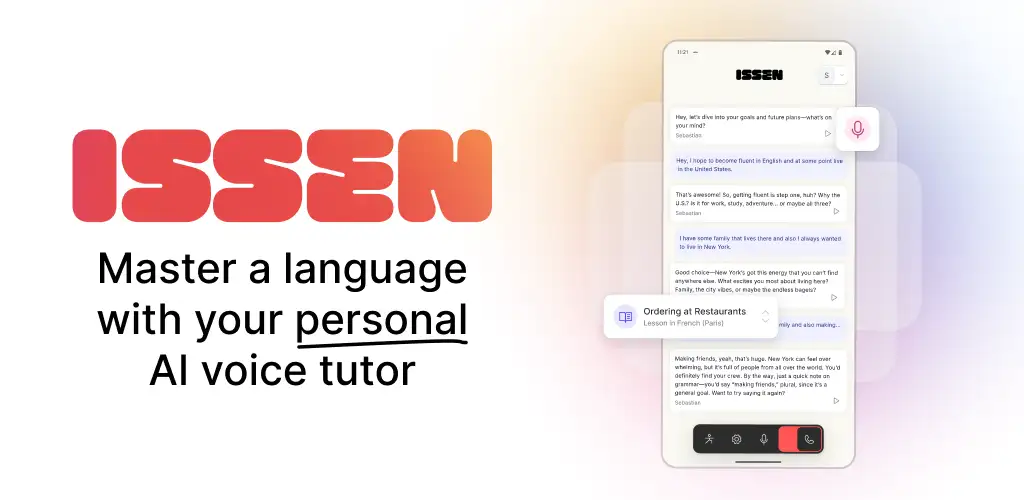
ISSEN closes the gap most plans miss: spoken output volume and real-time correction. Our AI voice tutor drives conversations, adapts register when you shift from small talk to technical explanation (a broader shift covered in how AI language tutoring is changing fluency for working professionals), and pulls new words into flashcards tied to the sentence you actually used. Background mode turns a commute into speaking reps. Accents span American, British, and Australian.
Treat ISSEN as one input alongside grammar study, reading, and the occasional human tutor. What we solve is the scheduling and cost ceiling on daily reps. The 10-minute free trial shows where your production breaks under pressure.
Where this is heading
Consider Priya, a data scientist in Bengaluru starting a client-facing role at a US insurance firm in six months. She reads technical English fluently but has never defended a modeling choice to a skeptical VP over Zoom. The tutor she practices with already knows her domain vocabulary, her tendency to hedge, and the stakeholder types she will face. Ten minutes a day compounds into hundreds of unscripted reps by the time the first call lands.
Final thoughts on English proficiency and professional opportunity
Your reading level and your speaking level are probably not the same, and the lower one is what gets assessed first in interviews and leadership reviews. Closing that gap takes consistent spoken output in settings where you can afford to stumble. Ten minutes a day compounds faster than most learners expect. Start a free 10-minute session with ISSEN and get a real sense of where your production stands.
FAQ
Does English fluency actually affect salary, or is that just career advice noise?
The data is specific enough to take seriously: in a global Pearson survey, 40% of non-native English speakers believed strong proficiency could raise their salary by 50 to 80 percent, and income satisfaction among advanced English speakers ran 28 percentage points higher than among beginners. The gap tracks who can hold an unscripted conversation when the stakes are high, not who scores well on a grammar test.
What English level do I need to be competitive for promotions and leadership roles?
B2 covers most professional roles: meetings, defending your work, client calls. C1 is where leadership access opens up, meaning the ability to present to executives, shift register mid-conversation, and negotiate without rehearsing. The trap most intermediate learners hit is reading at B2 while speaking at B1, and hiring managers notice which level is lower.
Can I improve my spoken English for job interviews using AI voice practice instead of a human tutor?
Yes, with one important caveat: AI voice practice like ISSEN covers the volume problem (daily unscripted reps with real-time response) that most interview prep plans are missing. A human tutor on Preply or italki is still worth a weekly session for targeted correction of errors that fossilize under pressure. Use both, with AI handling daily reps and a human tutor handling periodic course correction.
Why does my English freeze in meetings even though I understand everything being said?
Comprehension and spontaneous production are separate skills that develop at different rates, and most study methods only train the first one. Swain's Output Hypothesis explains the mechanism: producing language under real conversational pressure forces you to notice gaps that reading and listening glide past. Recognizing a word in a Financial Times article does not build the reflex to pull that word out mid-sentence while a stakeholder waits.
How does learning English to improve career salary prospects hold up as AI takes over more jobs?
Pearson's research found that roughly 40% of non-native speakers are now learning English to reduce AI's impact on their careers, which reflects a reasonable read of where automation pressure lands first. Codified, repeatable tasks get compressed. The work that survives requires judgment under conversational pressure: negotiating a contract redline, defusing a cross-functional call, briefing an executive on a slipped launch. Those exchanges turn on how well you speak, not how well you read.