
What Is Shadowing and Why It Improves Your Pronunciation (July 2026)
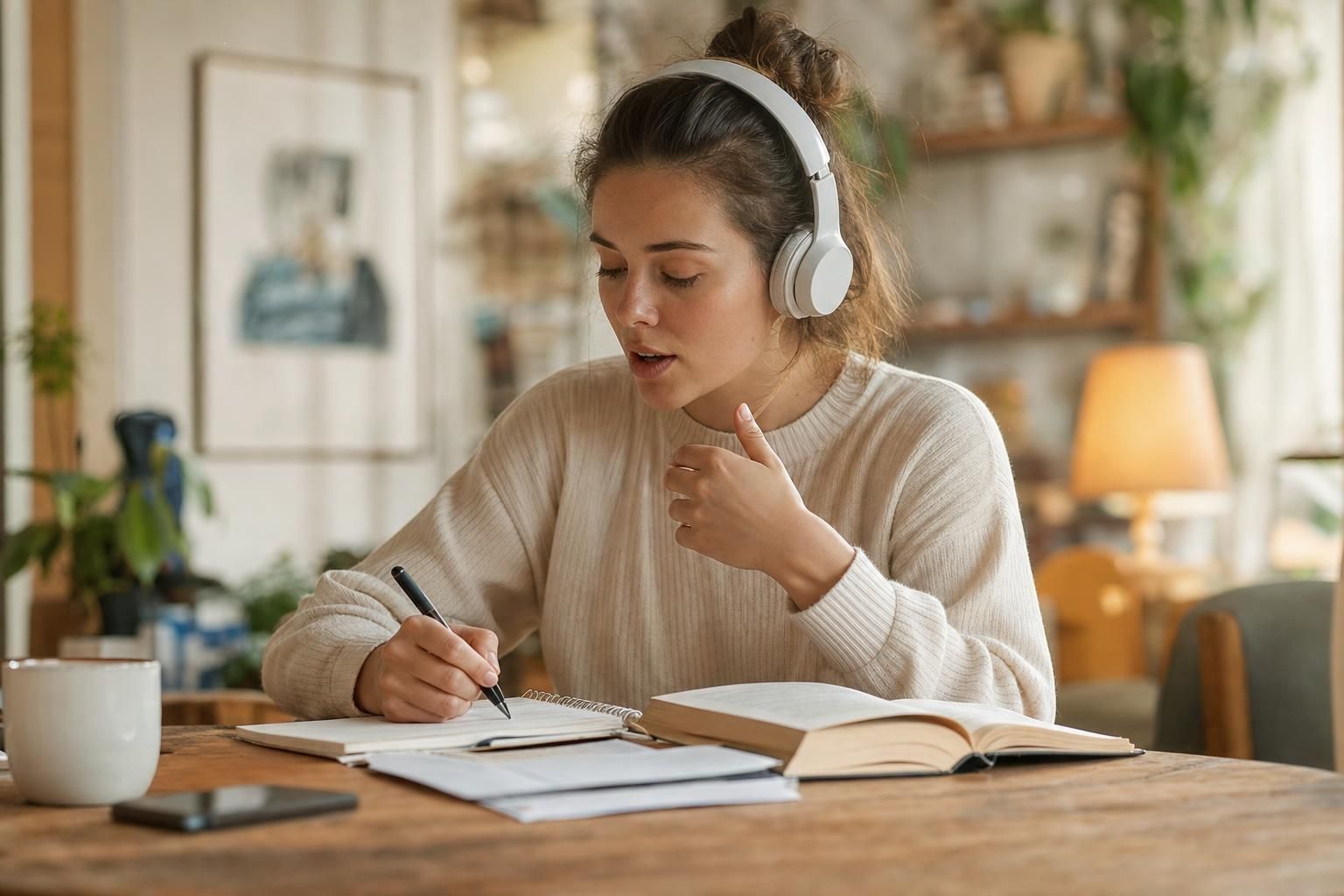
Repeating words slowly, drilling vowels, recording yourself saying sentences into the void, and still sounding like a textbook when you speak? That's a pretty common place to get stuck. Shadowing works on the layer most drills skip: the rhythm, the flow, and the way words blur together when a real person talks at full speed.
TLDR:
- Shadowing means repeating a native speaker almost simultaneously, trailing by a fraction of a second to copy rhythm, intonation, and pace as a single drill.
- A 2025 systematic review in Language Teaching Research found gains in comprehensibility, intelligibility, accentedness, and fluency from consistent shadowing practice.
- Shadowing works best at B1 and above for accent softening and connected speech; beginners who can't parse the audio mimic sounds without meaning.
- Run sessions for 15 to 20 minutes daily using natural-speed audio with a reliable transcript, and project at conversational volume, not a whisper.
- ISSEN has a dedicated Shadowing mode separate from voice conversations, with regional accent options including American, British, and Australian English, and Argentinian, Mexican, and Castilian Spanish across 60+ languages.
What is the shadowing technique
Shadowing is a drill where you listen to a native speaker and repeat what they say almost simultaneously, trailing their voice by a fraction of a second. You speak on top of them, matching rhythm, intonation, and pace as closely as your mouth can manage.
The technique was formalized by polyglot Alexander Arguelles, who used it across dozens of languages, and it has since been adopted by AI speaking practice tools that build on its core mechanics. He would walk briskly outdoors, headphones on, voice raised, shadowing audio aloud with upright posture. The drill trained ear and mouth together in one session.
The name comes from the mechanic. Your voice acts as a shadow of the speaker's: if they pause, you pause; if they rise in pitch, you rise; if they compress two words into a mumble, you compress the same two words the same way.
In practice, sessions run short and focused with a transcript nearby. You loop a passage, shadow it several times, check the transcript for anything you missed, and move on. It sits closer to physical training than to study.
The science behind why shadowing works
Three mechanisms are doing the work under the hood.
The first is the phonological loop, the short-term memory system that holds sound patterns just long enough for you to repeat them. Shadowing keeps that loop under constant load. You cannot pause to translate silently, so your brain encodes rhythm, stress, and intonation as sound, not as spelled words.
The second is the pairing of Krashen's comprehensible input (i+1, material just past your current level) with Swain's Output Hypothesis, which argues that producing language forces you to notice gaps pure listening lets you glide over. Shadowing collapses both into one activity.
The third is the kinesthetic angle. Arguelles recommended walking briskly while shadowing. The upright posture opens the diaphragm, changing how your voice carries and how closely you can match a native speaker's projection.
What shadowing actually improves
Shadowing pays off on the parts of speech that make you sound like a person, not a textbook reader.
A 2025 systematic review in Language Teaching Research reports gains in comprehensibility, intelligibility, accentedness, and fluency, along with prosodic features like rhythm, intonation, and pitch. Hamada's earlier work documents listening comprehension gains from consistent shadowing, since your ear trains on connected speech at native tempo.
Where the evidence thins is individual sound segments. If your target language has a vowel your mouth has never made, shadowing alone will not always fix it. Prosody and flow respond fastest. Isolated phonemes usually need targeted articulation work alongside the drill, and pairing shadowing with other effective language learning techniques speeds up the gaps it leaves behind.
Who benefits most from shadowing
Shadowing rewards learners who already have the raw materials in place. If you can parse most of what a native speaker says at natural speed, and you have a pronunciation baseline you want to sharpen, this is the drill that will move you fastest.
Beginners get less out of it. Audio pitched above your comprehension level becomes noise you mimic without understanding, training mouth movements but little else.
Match the method to the goal:
- Strong fit: accent softening, prosody, connected speech, listening at native tempo, breaking a fluency plateau
- Weak fit: building vocabulary from zero, learning grammar rules, reading comprehension
If you sit around B1 and up and freeze when speaking a foreign language at native pace, shadowing is worth the investment now.
How to shadow: a step-by-step process
Pick a clip between 30 seconds and 2 minutes long, spoken at natural native pace. Podcasts, interviews, and audiobook excerpts work well. Avoid slowed-down learner audio, which trains your ear on a tempo you will never hear in real conversation.
Then run the passage through this sequence:
- Listen once with no output. Notice where the speaker breathes, pauses, or speeds up.
- Shadow without the transcript. Trail the voice by a fraction of a second and copy the melody.
- Shadow with the target-language transcript in front of you.
- Shadow with a side-by-side translation to lock meaning to sound.
- Loop the passage 3 to 5 more times without any text.
Do this on your feet. Walk briskly, keep your posture upright, and project at conversational volume or louder. These are the same principles that apply to solo language speaking practice more broadly. The physical component is not optional in Arguelles' method; a slumped whisper trains a slumped, whispered voice.
Keep sessions to 15 or 20 minutes and run them daily. Five focused sessions across a week beat one 90-minute grind on Sunday.
Choosing the right material for shadowing
Good material has three non-negotiable properties: a clear native speaker at natural speed, a reliable transcript, and difficulty at your i+1 (you catch most of it, but not all).
Where to find clips that meet the bar:
- Podcasts with published transcripts. News shows and interview formats work well.
- Audiobooks paired with the printed text. One paragraph at a time is plenty.
- YouTube videos with human-checked captions. Auto-captions drift on fast speech and accents, so verify before committing.
- Structured courses like Assimil, designed around bilingual texts and short native-audio dialogues, share the same properties that define what makes a language learning app immersive.
On accents, do not lock yourself to one voice. Rotating through multiple talkers tends to build stronger speech perception than drilling a single speaker repeatedly. Rotate through two or three voices across a week: different genders, different regional accents within your target dialect group.
Common mistakes that reduce shadowing results
If shadowing feels like you're getting nowhere, one of these is usually why:
- Audio too far above your level. If you catch under half of what the speaker says, you are mimicking sounds without meaning, and the mouth work will not carry into real conversation.
- Mumbling under your breath. Quiet shadowing trains a quiet, hedged voice. Project at conversational volume.
- Skipping the transcript. Without a check step, you cement whatever you guessed wrong on pass one.
- Sporadic practice. Two heroic sessions a month build nothing. Fifteen minutes most days does, and AI apps for language conversation practice make it easier to hit that daily target.
- Chasing speed over accuracy. If you cannot match rhythm at native pace, drop to a slower clip before pushing tempo again.
Shadowing compared to other pronunciation methods
Shadowing is one tool in a pronunciation stack, not the whole stack. Cross-shopping the options helps you spend practice time on the right drill for the right problem.
Method | What it trains | Where it falls short |
|---|---|---|
Shadowing | Prosody, rhythm, connected speech, fluency at native tempo | Individual sound segments your mouth has never produced |
Listen-and-repeat | Careful reproduction with think time | Removes the simultaneity pressure that builds real-time processing |
Isolated sound drilling | Specific phonemes (rolled r, French u, Mandarin tones) | Does not carry into connected speech |
Recording yourself | Noticing your own errors on playback | No live model, no rhythmic pressure. Pairing recording with an AI voice tutor for language learning adds the real-time pressure recording alone cannot |
Stack them. Drill a tricky phoneme in isolation, shadow a passage that contains it, then record yourself reading that passage and compare against the original. Then look at the best language learning apps for speaking to find tools that support each layer.
Practice shadowing with ISSEN's dedicated shadowing mode
Our Shadowing mode sits in its own space in the app, separate from voice conversations. If you want options beyond shadowing alone, the best AI language tutors for conversation practice covers those in depth. The split is deliberate: pronunciation drills work differently from open dialogue, and combining them waters down both.
Inside the mode, you shadow native-speaker sentences with pause-and-repeat controls. Set how many times each sentence loops before advancing, so a phrase that needs 6 passes gets 6 passes without you tapping anything.
Accent selection matters here. Pick American, British, or Australian for English. Pick Argentinian, Mexican, or Castilian for Spanish. The same regional range extends across 60+ languages, so the voice you shadow matches the dialect you plan to speak.
Try it free for 10 minutes at issen.com.
Final thoughts on the shadowing technique for language learning
The shadowing technique has been around for decades, and the evidence for it keeps holding up because the mechanism is sound: you produce language under real-time pressure, your brain encodes rhythm and intonation as sound instead of text, and your mouth builds the muscle memory to match. It rewards consistent short sessions far more than occasional long ones, so the barrier to starting is lower than it looks.
Consider where this is going for someone like Priya, a supply-chain analyst in Bangalore who passed her C1 English exam two years ago but still stumbles in fast-moving client calls with her team in Chicago. Right now, she shadows 15 minutes of meeting recordings each morning before logging in. Within two to three years, tools in this category will likely surface those exact recordings automatically: flagging the two seconds where her cadence broke, looping that clip, and queuing the next one before she has to think about it. The drill stays the same; the friction of finding and managing material disappears. For Priya, that means more reps in less time, compounding the gains she is already building today.
Pick a 60-second clip you can mostly follow, get on your feet, and shadow it five times today. If you want a structured place to do exactly that, ISSEN's dedicated Shadowing mode is free for the first 10 minutes.
FAQ
What is the shadowing technique in language learning, and who actually benefits from it?
Shadowing is a drill where you trail a native speaker's voice by a fraction of a second, matching their rhythm, intonation, and pace in real time. It was formalized by polyglot Alexander Arguelles as a method for training ear and mouth together in one session. The learners who get the most from it are those already at roughly B1 or above: if you can follow most of what a native speaker says at natural speed, shadowing sharpens the prosody and connected speech that make you sound fluent, not textbook-correct. Beginners working with audio above their comprehension level are mostly mimicking sounds without meaning, which builds very little that transfers to real conversation.
Can shadowing english speaking exercises fix my accent on their own, or do I need other drills too?
Shadowing moves the needle fastest on prosody, rhythm, and connected speech (the features that carry fluency), but the research is thinner on individual sound segments your mouth has never produced before. A 2025 systematic review in Language Teaching Research confirmed gains in comprehensibility, intelligibility, and fluency from shadowing practice, while isolated phonemes (think French nasal vowels or a rolled r) typically need targeted articulation work alongside the drill. The most effective approach stacks them: drill the tricky phoneme in isolation, shadow a passage that contains it, then record yourself reading that passage and compare against the original.
How do I find good shadowing english speaking practice material as a beginner to the method?
Your material needs three things: a clear native speaker at natural pace, a reliable transcript, and difficulty at your i+1 level, meaning you catch most of it, but not all. Podcasts with published transcripts, audiobooks paired with printed text, and YouTube videos with human-checked captions (not auto-generated ones, which drift on fast speech) all meet the bar; slowed-down learner audio does not, because it trains your ear on a tempo you will never hear in a real conversation. Rotating through two or three different voices (different genders, different regional accents within your target dialect) also produces stronger phonetic gains than drilling a single speaker repeatedly.
Shadowing vs listen-and-repeat for pronunciation practice: which builds faster results?
Shadowing removes the think-time that listen-and-repeat preserves, and that simultaneity pressure is the whole point: your brain has to encode rhythm and stress as sound instead of pausing to translate or deliberate. Listen-and-repeat trains careful, deliberate reproduction, which is useful early on but does not build the real-time processing speed you need when a native speaker talks at full pace. Use listen-and-repeat when you are isolating a new sound segment; shift to shadowing once you need that sound to hold up under conversational pressure.
How does ISSEN's Shadowing mode differ from its voice conversation sessions?
ISSEN's Shadowing mode is a structurally separate feature from voice conversation sessions. The split is deliberate, because pronunciation drills and open dialogue work differently and mixing them dilutes both. Inside Shadowing mode, you work through native-speaker sentences with pause-and-repeat controls, set the number of loops each phrase gets, and choose your target accent: American, British, or Australian for English; Argentinian, Mexican, or Castilian for Spanish, across 60+ languages total. Voice conversation sessions are a separate mode where the AI tutor drives real-time dialogue, adapts difficulty as you speak, and remembers your progress across sessions. Pronunciation correction does not happen inside those conversations.