
Spanish B1: What You Can Say and How to Get There (June 2026)

You understand Spanish well enough to follow along in most situations, but when the time comes to talk, the words don't come out as cleanly as they sound in your head. That's the moment most learners realize they're stuck between A2 and Spanish B1, where your listening and reading are stronger than your speaking. Reaching Spanish intermediate level means you can do more than order food or ask for directions; you can explain why you're calling, tell a story that mixes past and background details, and give reasons for your opinions without switching languages mid-thought. Getting to B1 Spanish requires focused work on a short list of grammar patterns and enough live conversation practice that paraphrasing around unknown words becomes automatic instead of something you think about.
Two years from now, María logs into her phone at 6 AM before her shift at the clinic in Guadalajara starts. Her AI tutor remembers she's preparing for her medical licensing exam interview next month, pulls vocabulary from her last three sessions about patient intake procedures, and runs a 15-minute mock interview at the exact formality level the licensing board uses. The tutor flags when she reverts to preterite in a sentence that needs imperfect, replays her answer at half speed so she hears the error herself, then moves on. By the time she clocks in, she's had 47 turns of speaking practice tailored to the exact scenario she'll face in four weeks. That level of personalized, scenario-specific drilling at scale is where AI tutoring is heading, and it changes what's possible for learners with real deadlines and limited budgets.
TLDR:
- B1 Spanish means you can tell past-tense stories, give opinions, and paraphrase around gaps.
- You need 1,500 to 2,500 active words and automatic control of preterite, imperfect, and subjunctive.
- Most B1 learners avoid the subjunctive in real conversation and lose comprehension at normal speed.
- Reaching B2 takes another 150 to 200 hours of speaking-heavy practice over 4 to 15 months.
- ISSEN offers on-demand voice practice with accent-specific tutors in Argentinian, Mexican, or Spain Spanish.
What B1 Spanish Actually Means
B1 is where you stop being a beginner and start being an independent user. You can handle travel situations, describe experiences in connected sentences, and follow the main points of a meeting when people speak clearly. The Council of Europe's CEFR descriptor covers experiences, events, wishes, and brief reasons for opinions and plans.
Here's what a real B1 exchange sounds like:
"Hola, eh... necesito hablar con alguien porque... mi calentador no funciona desde ayer. Bueno, funciona, pero el agua sale fria. Ya intente apagarlo y prenderlo otra vez, pero nada."
Notice the workarounds. You don't know "water heater" so you say "calentador." You can't find "reset" so you describe it. That instinct to paraphrase around a gap is the B1 skill that matters most.
The B1 Skill Checklist
Run through this list and check off what you can already do. For more on language learning strategies, visit the ISSEN Blog. The gaps tell you what to work on next.
Speaking
- Tell a past story using preterite and imperfect together (lo que hacía cuando pasó algo)
- Give your opinion with porque, creo que, and me parece que
- Describe your job, routine, or hometown for two minutes without stopping
- Paraphrase around unknown words instead of switching to English
Listening
- Follow a podcast episode on a familiar topic at normal speed
- Understand a phone call from your landlord or a clinic receptionist
- Catch the gist of a news segment about something you already know
Reading
- Read a news article and summarize it in your own words
- Follow an email thread about scheduling or logistics
Writing
- Write a short email canceling an appointment or changing a schedule
- Leave a WhatsApp message explaining why you are running late
- Fill out a form with personal details, dates, and short explanations
Typical Vocabulary Range at B1
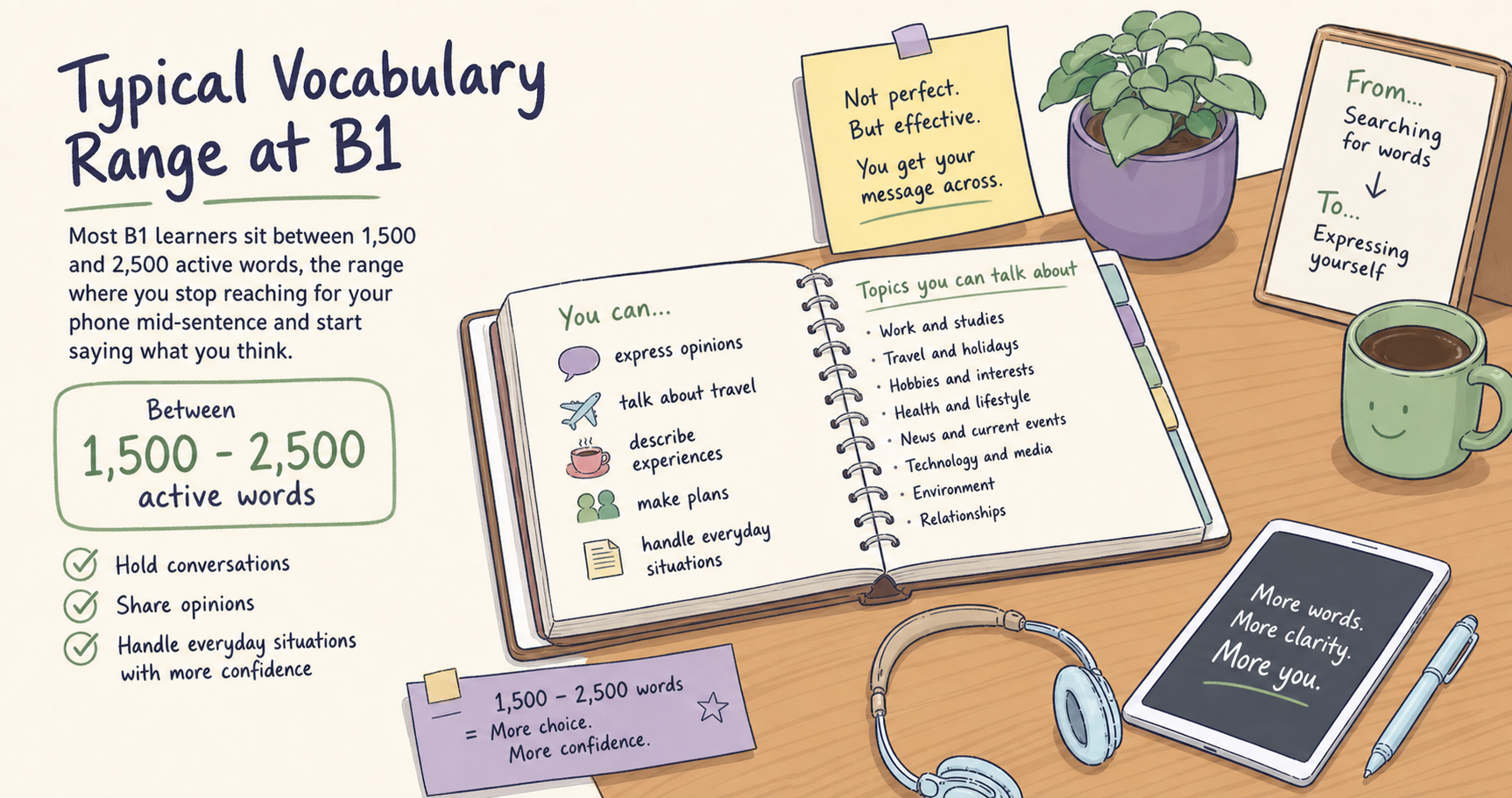
Most B1 learners sit between 1,500 and 2,500 active words, the range where you stop reaching for your phone mid-sentence and start saying what you think. In this band, you can follow conversations on familiar topics, read news articles, and handle most everyday exchanges.
The shift at B1 is qualitative. You move past survival vocabulary (water, bathroom, how much) into words that carry opinion, sequence, and texture.
Opinion vocabulary
- me parece (it seems to me)
- estoy de acuerdo (I agree)
- en mi opinion (in my opinion)
- depende de (it depends on)
- aunque (although)
Past-tense connectors
- mientras (while)
- de repente (suddenly)
- al final (in the end)
- antes de que (before)
- luego (then, afterwards)
Description terms
- amable (kind)
- aburrido (boring, or bored)
- tranquilo (calm, quiet)
- complicado (complicated)
- emocionante (exciting)
Grammar You Should Have Locked In
By B1, a handful of structures should feel automatic. You won't always get them perfect, but you should reach for them without pausing to translate from English first.
- Preterite vs imperfect for storytelling: Cuando llegué a casa, mi hermana ya estaba durmiendo.
- Present subjunctive after querer que, esperar que, dudar que: Espero que tengas un buen fin de semana.
- Simple future instead of always relying on "ir a": El próximo año viajaré a México.
- Pluperfect for sequencing past events: Cuando llamaste, ya había salido.
- Conditional for polite requests: ¿Podrías ayudarme un momento?
- Por vs para, relative pronouns (que, quien, lo que), and stacked object pronouns: Ya se lo di a Marta.
Where B1 Learners Get Stuck
Most B1 learners hit the same wall around the same time. The shape of the plateau is predictable, which is good news: if you can name what's stuck, you can work on it.
- You avoid the subjunctive in real conversation. You know the rule on paper, but in the moment you reach for the indicative because that feels safer.
- You lose comprehension once native speakers hit normal speed. Textbook audio runs 20 to 30 percent slower than real Spanish at roughly 6 syllables per second.
- You overuse the same 30 verbs. Ser, estar, tener, hacer, ir, poder, querer, decir. You sound like a confident A2.
- Por vs para falls apart mid-sentence with a clock running, even when you ace fill-in-the-blank exercises.
- Multi-speaker conversations leave you behind. One-on-one is manageable; three friends talking over each other is a different sport.
- Preterite vs imperfect collapses under spontaneity. Telling a story in real time, you default to whichever ending feels familiar.
The common thread is reps. You've read enough. What's missing is live attempts where the stakes are low and someone is listening.
How to Break Through to B2
A weekly plan that moves you from B1 to B2 looks like this. If you need on-demand speaking practice, ISSEN offers real-time voice sessions adapted to your level.
- 3 to 4 voice sessions per week, 20 to 30 minutes each, focused on WEIRDO subjunctive triggers (wishes, emotions, impersonal, recommendations, doubt, ojalá) and past-tense storytelling.
- 30 minutes of daily listening at 0.9x speed for two weeks, then ramp to 1.0x. Pick one podcast and stick with it.
- 10 to 15 new words a day pulled from what you actually heard or read, reviewed with spaced repetition.
- One grammar gap per week, drilled in conversation.
B1 to B2 typically takes another 150 to 200 hours on top of the roughly 400 hours to reach B1.
Using an AI Tutor at B1 Spanish
At B1, the bottleneck is volume of speaking, not knowledge. A voice tutor gives you cheap, on-demand reps where you can stumble through the subjunctive, fumble a past tense story, and try again 30 seconds later. ISSEN adjusts difficulty in real time and holds conversation in Argentinian, Mexican, or Spain Spanish.
Four prompts worth rotating through:
- "Cuéntame qué vas a hacer este fin de semana" for future tense and weekend plans
- "Cuéntame una historia de tu infancia" to mix preterite and imperfect
- "Recomiéndame una serie buena para mi nivel" for subjunctive after recomendar que
- Role-play returning a defective product, with the tutor as the store clerk
Sample Conversation at B1
Here is a realistic exchange between Ana (B1) and her friend Luis, planning a weekend trip to Mexico City.

Luis: Oye, ¿al final vas a ir a la Ciudad de Mexico el sabado? Ana: Si, espero que el vuelo no se retrase porque la ultima vez llegue cinco horas tarde. (1)Luis: Uf, que mal. ¿Y donde te vas a quedar? Ana: En un hotel cerca de Coyoacan. Cuando fui hace dos años, me quede en el centro, pero habia mucho ruido por la noche. (2)Ana: Aunque me gusto, esta vez quiero algo mas tranquilo. (3)Luis: Buena idea. ¿Vas a visitar a Marta? Ana: Si, eh... ¿podrias darme su numero? Lo perdi cuando cambie de telefono. Lo perdí cuando cambié de teléfono. Si me lo mandas, se lo escribo hoy mismo. (4)
What's happening at B1:
- Espero que + subjunctive (se retrase), then preterite (llegue) anchoring the past.
- Preterite (fui, me quede) and imperfect (habia) handling background versus completed action.
- Aunque as a connector. Ana reasons out loud.
- Podrías + infinitive for a polite request, plus stacked pronouns (me lo mandas, se lo escribo). The "eh..." is honest B1 texture.
How Long to Reach B2
Plan that 150 to 200 hour gap against your weekly reality and the math gets honest fast:
Weekly commitment | Time to B2 |
|---|---|
10 hours/week | 4 to 5 months |
7 hours/week | 6 to 7 months |
5 hours/week | 8 to 10 months |
3 hours/week | 12 to 15 months |
Speaking-heavy weeks move the needle faster than reading-heavy ones. The Foreign Service Institute puts professional working proficiency in Spanish at roughly 600 to 750 classroom hours, with the back half of that range covering B2.
At B2, native speakers stop slowing down for you. You hold your own at a group dinner, sit through a meeting without dropping out, and watch a series without subtitles after the first episode.
FAQ
Am I really at B1 or still A2?
If you can tell a story in past tense and give reasons for your opinions without rehearsing, you're at B1. If you still string short present-tense sentences together and lean on memorized phrases, you're A2.
How do I test my Spanish level?
The Instituto Cervantes runs the DELE exams, which certify CEFR levels from A1 through C2. For a faster check, take a free online placement test, then sit a 20-minute conversation with a tutor.
Can I skip B1 and jump to B2?
You can't skip the hours, but you can compress them. B2 grammar assumes B1 grammar is automatic. Drill the B1 structures until they come out without thinking.
Is B1 enough for travel, work, or living abroad?
B1 covers travel, apartment leases, doctor visits, and friendships. Most office jobs in Spanish-speaking countries want B2. Customer-facing roles often need C1.
What is the fastest way to leave the B1 plateau?
Speaking volume. Most B1 learners have read and listened plenty; what's missing is hours of live output where you fail in real time and try again.
Final Thoughts on Reaching B2 From B1 Spanish
B1 feels like being stuck in the middle because you are stuck in the middle. You're past survival mode but still pausing mid-sentence to mentally translate grammar you thought you knew. The only fix is speaking enough that those structures stop being decisions and start being reflexes. ISSEN gives you on-demand conversation practice so you can drill the subjunctive, mix past tenses, and paraphrase around vocabulary gaps without waiting for a tutor to have a slot open. The plateau ends when your weekly speaking hours finally match the hours you spent reading to get here.